Much of what will be said here refers to the knowledge mentioned in the last post, about blood.
The name ‘Rh’ is an acronym for ‘Rhesus factor’. This is because the first time scientists observed the Rh factor was during a blood analysis of Rhesus monkeys. Since then, we have discovered that Rhesus molecules are present in most life forms. Even some kind of bacteria carries Rh molecules.
The Rh factor has an ancient origin, descending from the Amt molecule, which is found in every living thing, including Archea, the oldest living organism on Earth.
Although Rh varies between species, they all have the same function. The similar DNA instructions they have are to carry and distribute gases within cells. The Amt do the same. They have a similar DNA to Rh molecules.
The Rh factor is almost like a simplified version of the dynamics behind blood types. There are two main options: your Rh factor can be either positive or negative.
As you probably remember, we all have two copies of almost all our genes, one from each parent. The RHD gene can have at least two versions: positive and negative. It’s easy to assume that two RHD+ genes will result in Rh+ blood. The same can be assumed with two Rh-.
If one parent gives you an Rh+ gene and the other gives you an Rh- gene, you will be an Rh+ carrier for Rh- blood. This is because people with just one RHD gene produce enough protein to be Rh+. If you are Rh-, neither of your RHD genes knows how to produce the RHD protein.
In simple terms, if you are Rh-, both of your parents must be carriers of the Rh- version of the RHD gene, which is fairly common.
If you are a woman intending to become pregnant, it is important to be aware of the possibility of Rh incompatibility during pregnancy. This can happen if the mother is Rh-. This wouldn’t affect the first pregnancy, but could lead to problems in subsequent pregnancies.
This is because, during birth, the blood of the mother and baby mixes. In an Rh- mother, her immune system is unable to recognise the Rh+ in the baby’s blood, so it will produce antibodies against it. This process takes time, so it will not be a problem for this pregnancy, but it will affect subsequent pregnancies.
Since the mother’s immune system will already have antibodies against Rh+, her body will see the baby as an intruder and attack any Rh+ cells in the unborn baby. This is called Rh disease of the newborn. But there’s no reason to be afraid, since if you need, you can take a couple of RhoGAM shots during pregnancy, that prevents the mother’s immune system from harming the unborn baby.
The RhoGAM’s function is to absorb all the Rh+ cells released from the baby, thereby preventing the mother’s body from mounting an immune response to them.
My four-year-old daughter started the day by asking me a question about blood types. I was delighted to have the opportunity to share some of my knowledge on the subject with her. It made me want to go back to all those genetics classes I used to have and try to explain everything in a way that made sense. Since she didn’t seem interested in the topic, I’ll quickly run through a few things about blood types and Rh factors here (it’s a public holiday today, so I have some time).
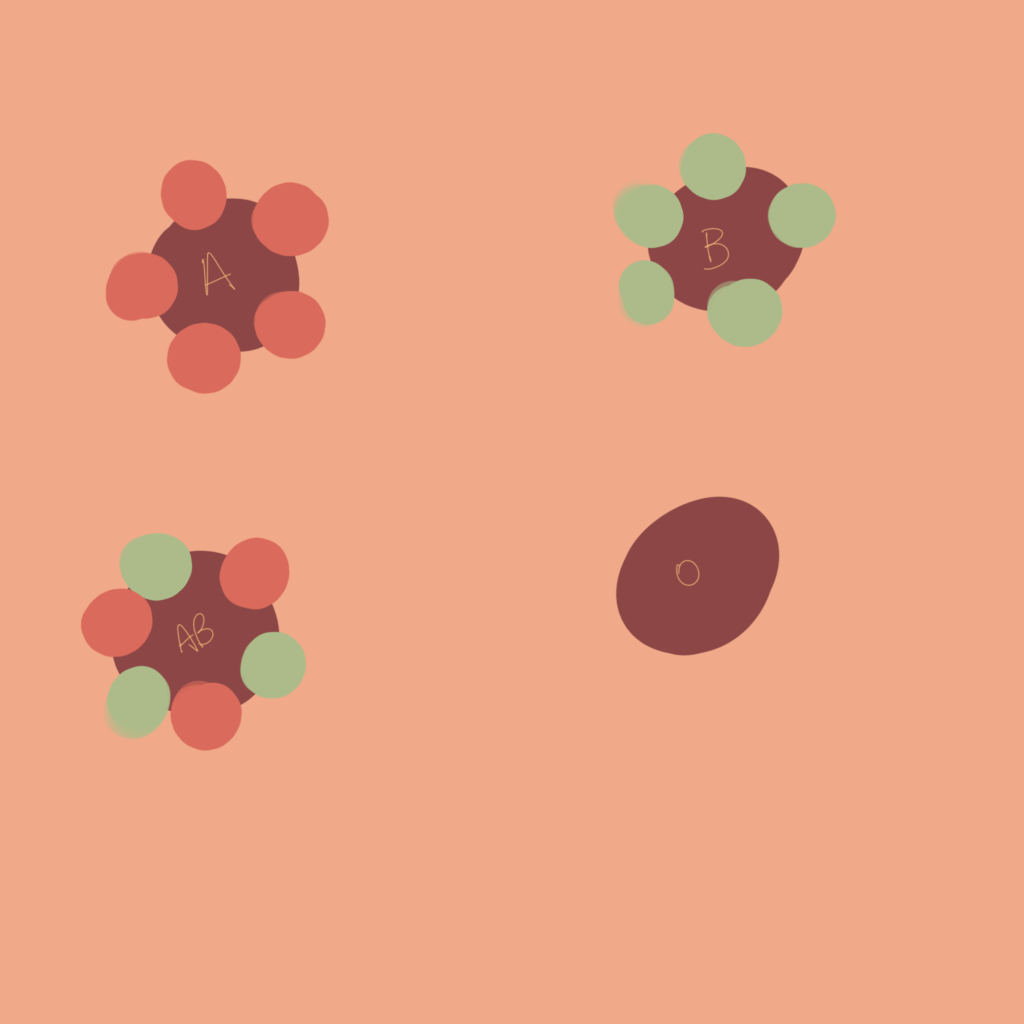
possible blood types
Like many of our traits, blood types are genetically inherited. In simplified terms, it’s important to remember three things:
We have two copies of almost all of our genes.
Genes act as recipes for making proteins.
We have something called alleles, which are different versions of our genes.
Our blood type is determined by three different versions of a gene, which we can call ABO.
Since we inherit two versions of each allele, one from our mother and one from our father, each of our two copies can have a different version. The following table is a straightforward way to comprehend this:
Genesinherited
Blood typeresultant
AA
A
AO
A
BB
B
BO
B
AB
O
OO
O
There are tiny details outside our blood cells called antigens. It’s pretty simple.
Blood type
Antigen
A
A
B
B
AB
AB
O
NO PROTEIN
However, there is always an interesting new factor to consider: our DNA can change. It’s expected to change during our lifetime since there are many factors that can cause mutations in our DNA, such as our diet, sun exposure, age and chemicals in the air.
These include our diet, sun exposure, age and chemicals in the air. It is thought that everyone had type A blood in the distant past, and that types B and O are mutations.
DNA is made up of four different elements, which we call bases. Each gene is a formula for making a protein.
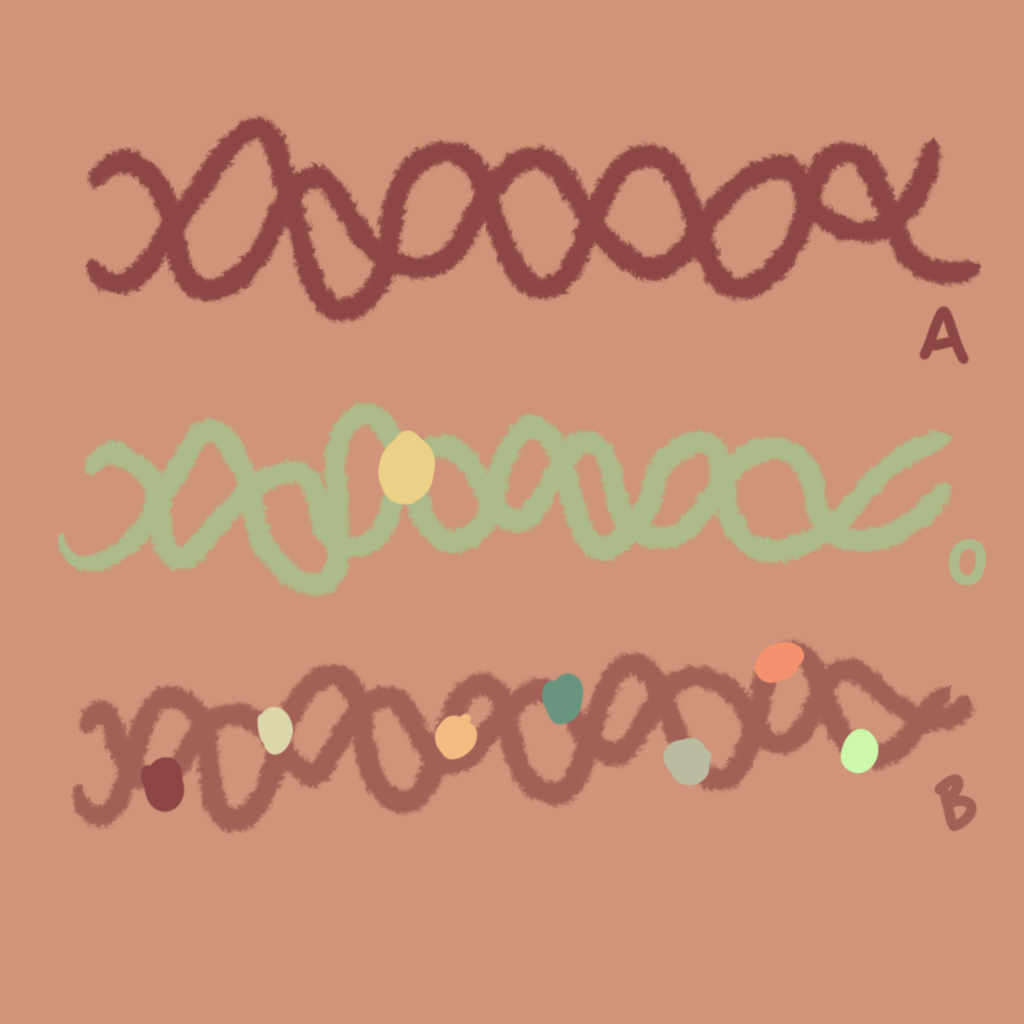
The difference between type A and type O is one base (type O is missing this base), while the difference between type A and type B is seven bases.
Our genes are read by cells in groups of three bases. Therefore, if just one base is different, it can alter the entire code. O is simply a modified version of A, which occurred at some point in the distant past and was able to survive and spread successfully.
This justifies a mutation leading from an A type to an O type.
We can also observe that an O type can generate an A type, but this is much rarer. The odds of this specific change occurring are around 1 in 50 million. Therefore, it is possible for two type O parents to have a type A child, but it is not very probable.
Similarly, it is possible for O-type parents to have a B-type child, but this is highly unlikely, as it is improbable that seven bases would change simultaneously to produce a recipe for B-type blood from O-type blood.
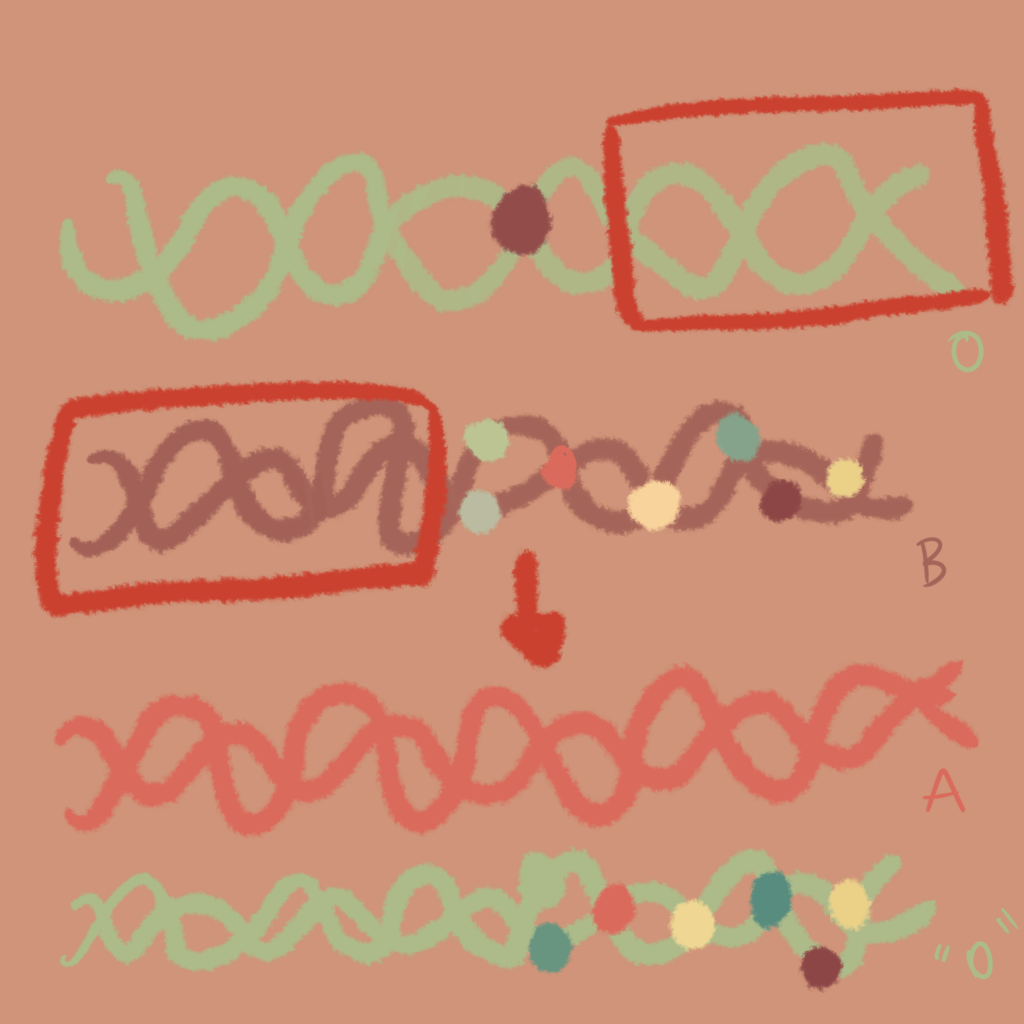
There are different types of mutation that can result in two B-type parents having an A-type child. This happens because of recombination.
Since each person has two different forms of a gene (called alleles), one from each parent, we can see how recombinations can occur.
An example:
A woman have type B and type O alleles, which results in type B blood. When her body produces eggs, it chooses which allele it will carry. It can be type O, coming from one parent, or type B, coming from the other.
Type O alleles are almost type A alleles, they’re just missing one little base. If, for a reason, this one base is replaced, it can works just like a type A.
Recombination, where we swap part of O of B, making an A type.
This way, if this woman have children with a O type father, the child could have A type blood, even though neither parent have an A type allele. If she have kids with an B type man, the child could have AB blood type.
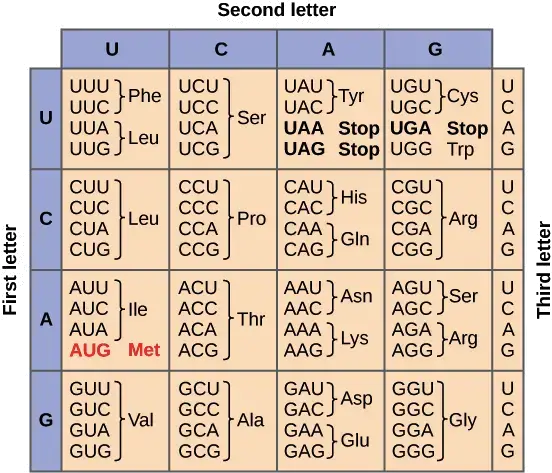
We have something called amino acids, that are like Lego parts to build a protein. There are 20 different types of this building blocks.
The ABO gene have the following sequence of DNA Bases:
GTC CTC GTG GTG ACC CCT TGG
This sequence is read by the cell as instructions to make a protein using the following amino acids (Lego pieces):
Val Leu Val Val Thr Pro Trp
What if one of the “G” base, right on the middle, is taken out? All the following bases would get shifted to the left, resulting in something like
GTC CTC GTG GTA CCC CTT GGC
Which would result in a protein builded with the pieces
Val Leu Val Val Pro Leu Gly
This is a mutation. As you can see, it’s a completely different set of amino acids (what makes a totally different protein!).
How the cell know when it reached the end of the gene, so it can stop reading? As you can see on the table above, there’s certain combinations that acts like a stop sign. In this case, when the “G” base got missing, the cell finds a stop signal earlier than it should. This is exactly why two type A can have type O children!
rare exceptions on blood type inheritance
There are rare exceptions on the blood rules. We can basically summarise it as
Chimerism
Cis-AB type
Uniparental dissomy
Bombay group
New Mutations
chimerism
We call chimerism when one person has two different sets of DNA. It can happen because of:
Bone marrow transplant, when the recipient will have the blood type of the donor, but their sperm or eggs would still have the original DNA and blood type
Fusion chimerism, when a twin pregnancy combines generating a single baby with both twin’s sets of DNA
Blood chimerism, when fraternal twins share blood during pregnancy, causing mixing cells
cis-AB TYPE
There’s a rare version of ABO gene, which can result in AB type by itself. On this case, two AB parents could have an O type child and one AB type parent + one O type parent could have an AB type child.
uniparental dissomy
It happens when a child inherits both sets of chromosomes from a single parent. It’s very rare.
bombay group
It’s a recessive blood type caused by a variant at different blood type genes. This type look like an O type, no matter which ABO type they have.
new mutations
This is pretty rare, but new and less documented mutations can occur.
When we consider this exceptions, the have a table of combinations that look like that:
possible blood types chart
Parent 1
Parent 2
Expected blood type resultant
Rare exceptions
A
A
A, O
B, AB – If either parent is a chimera
A
B
A, B, AB, O
Non existent
A
AB
A, B, AB
O – If the AB parent is a chimera or has cis-AB type. Also possible that both parents carry Bombay group
A
O
A, O
B – If either parent is a chimera or if O parent carries Bombay AB – If the O parent is a chimera or carries Bombay
B
B
B, O
A, AB – If either parent is a chimera
B
O
B, O
A – If either parent is a chimera or if the O parent carries Bombay AB – If the O parent is a chimera or carries Bombay
AB
AB
A, B, AB
O – If both parents are carriers of Bombay or have cis-AB type
AB
O
O
O – If the AB parent is a chimera or has cis-AB type or if both parents carriers Bombay AB – If the AB parent has cis-AB type or if the O parent carriers Bombay
O
O
O
A – If either parent is a chimera or carriers Bombay B – If either parent is a chimera or carriers Bombay AB – Both parents are chimera or carriers of Bombay group
Besides blood types, there’s also a lot of things to consider when we think about Rh factor, but this will have to be discussed on a further post, since Fritz is already boring meowing for me.