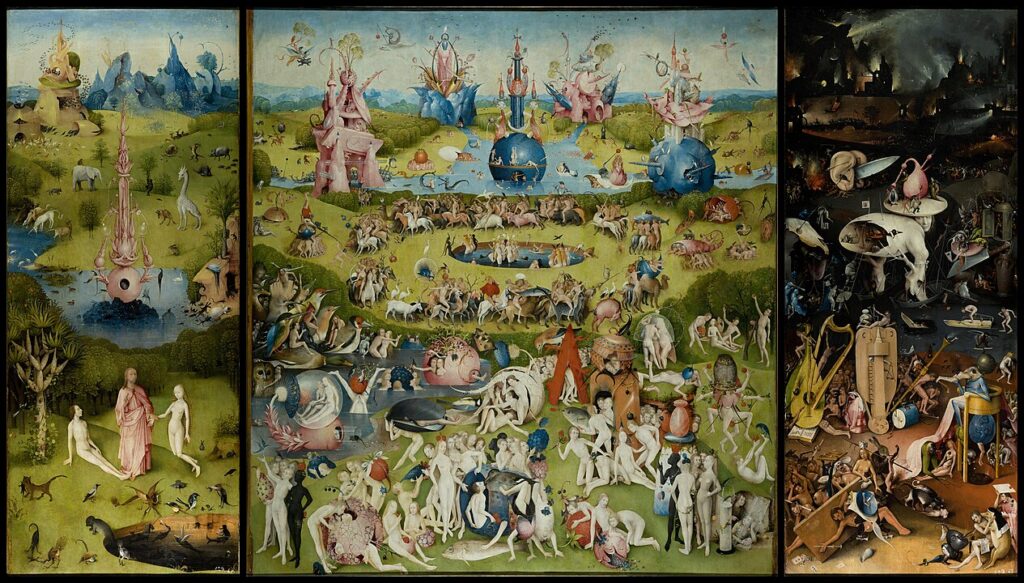
The paint delineates the world, commencing with creation on the left side and culminating in hell on the right.
The left side, Eden’s garden
On the left side of the paint, the creation, where the spring of life can be observed. However, an image then emerges that is wholly unanticipated and not directly associated with the customary imagery associated with the act of creation. It is conceivable to perceive God, embodied by an antiquated paradigm during Boch’s era, in the form of the figure of Christ. Eva’s genesis was recent, and she was positioned on the ground, in a state of supplication, with her hand held out towards the divine. Adam is depicted in a state of immobilisation, seemingly paralysed, gazing upon the original sinner who would subsequently repudiate the sanctity she had once acknowledged. It is conceivable to interpret the palm as the “tree of good and evil” on the basis that it is adorned with a snake.
It is possible to interpret the initial segment of the painting as a prologue, hinting at the subsequent events that are to be depicted. On initial observation, the garden may appear to be a tranquil setting. However, upon closer inspection, several indications of turbulence emerge. The animals, engaged in combat, appear to be in staunch opposition to the notion of peace in a paradisiacal garden. These creatures can be interpreted as symbols of sin. The demon is hardly visible, lurking. It can be hypothesised that the cathedral, situated at the core of the composition, serves as a representation of the phallic symbol. This symbolisation could be interpreted as a representation of the sin of the flesh.
the middle panel, the garden of earthly delights
The image in question can be interpreted as a representation of desire, or more specifically, of a world in which the concept of paradise has been distorted, resulting in a semi-hellish environment.
Whilst superficially appealing, a thorough examination reveals that it is representative of a corrupted humanity, one that is closer to hell and eternal damnation. This section of the painting is characterised by the presence of a significant amount of imagery, which serves to represent erotic themes and sexual practices. The depictions encompass both heterosexual and homosexual engagement. Interpretation of sexual interaction, even between animals and plants, is a further avenue for exploration.
The fruits, frequently employed as a symbol of carnal desire, also functions as a metaphor for the ephemerality of sensual gratification, given that it is rapidly consumed and rapidly deteriorates. In the period of artistic production under discussion, avian imagery was frequently employed to symbolise lewdness.
It is evident that the inferior portion is replete with characters. However, upon closer inspection, one may discern that the figure almost concealed within the cave is Eva, with Adam positioned behind her. Adam is depicted as experiencing regret for his decision to consume the prohibited fruit and glaring at the world of doom in which he now finds himself ensnared.
the right side, the hell
It may appear to be an intriguing phenomenon, the extent of musical elements represented in hell. It is noteworthy to observe that by the era of the painting, Boch and numerous other figures had associated music with sin.
The paint on this side is characterised by a sense of overwhelming aura, marked by a multitude of intricate details. The classical image of hell is characterised by depictions of fire and torture, which may be reminiscent of a city engulfed in flames.
At the centre of the composition is a figure that is severely disfigured, with demonic entities manifesting as if dancing upon its cranium. The interior was devoid of life, occupied solely by a multitude of oppressive monsters. In the medieval period, it was a common practice to portray the contrast between extreme heat and bitter cold as a form of torture reserved for the infernal realm.
In the lower section, the concept of music as a domain for sinners is emphasised, with musical instruments being depicted as instruments of torture. Additionally, the presence of a male figure holding a pig is noteworthy, which may symbolise regret and serve as a reference to the actions of men in the central panel.
Evidently, there is a plethora of observations and interpretations to be made. This is an artwork that can be reimagined on numerous occasions throughout the course of a lifetime.