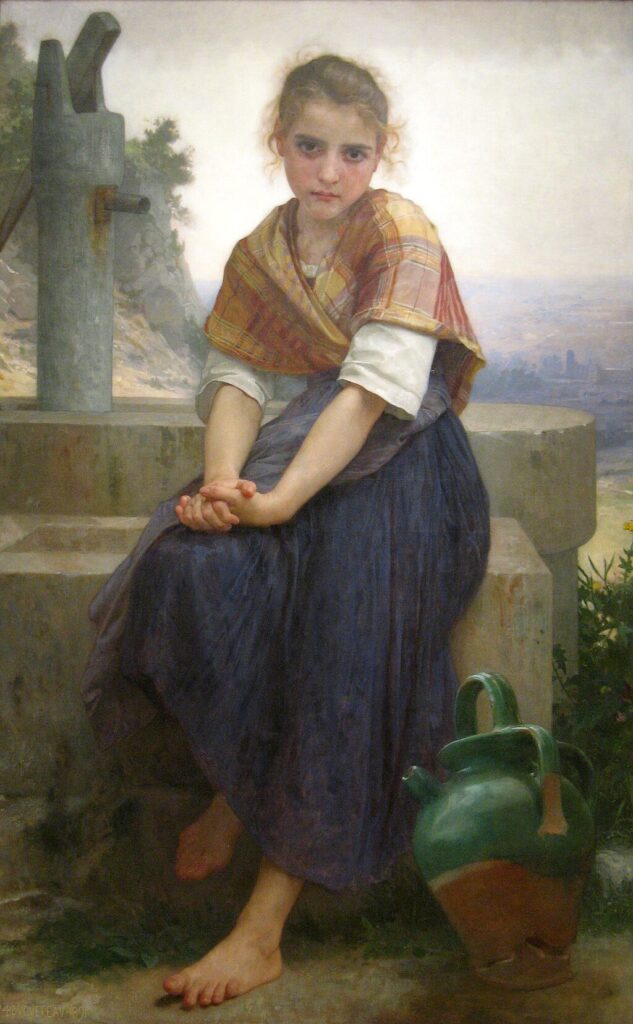
- The subject’s eyes appear to be incongruent with her age, suggesting the presence of more profound sentiments, potentially associated with anger or a predatory disposition.
- The girl’s face appears slightly flushed, specially on the area of the cheeks, and beneath the eyes there are dark circles, indicating that she may have either wept or been deprived of sleep.
- Notwithstanding the evident despondency conveyed by her posture and gaze, she is not weeping, nor does she exhibit any overt signs of distress. Rather, she appears to be making a conscious effort to maintain a neutral expression.
- Painting of this nature, which was prevalent during the nineteenth century, frequently conveyed meanings related to vulnerability, sexual availability and emotional disturbance through the depiction of hair (Jones 1998, p. 123).
- The subject has arranged her hair in a simple, minimalist style, with the back section tied back. This is an indication of decorum and humility, and the loose strands of hair serve to emphasise a sense of naturalness and simplicity, maybe rather than a rigid and overly contrived aesthetic. It is conceivable that the image in question may be a representation of post-sexual hair, characterised by its untidy state.
- Determining her age is a challenging task, as there appears to be a dispute between the concepts of girlhood and womanhood.
- It can be posited that the rigidity observed in this subject’s shawls is indicative of an internal struggle to maintain composure and self-possession, despite the presence of conflicting emotional sentiments.
- The subject’s skin is characterised by its softness, pallor and evenness. These attributes can be interpreted as signals of innocence; however, no additional signals of innocence are evident in the painting.
- It is possible that the body language of the subject could be interpreted as indicating feelings of shame and fear. This would include a slight hunching of the body, particularly of the shoulders, and arms held close to the body, which could be seen as a defensive gesture. Concurrently, it is not possible to ascertain whether she appears to be surprised. It is as if she was aware that the act was irreversible and perhaps even consented to it.
- The subject is depicted without any shoes on, and in a state of exposed vulnerability. The notion of “childishness” is frequently associated with the concept of “barefootness“, yet the subject in question has seemingly transcended such a state. One foot is retracted, while the other remains in contact with the ground. This positioning may be indicative of a certain lack of formality, a degree of comfort, or even one more symbol of a vulnerability.
- Her hands are firmly clasped, as if attempting to hold together a damaged object. She appears to be defensive in manner and exhibits a sense of unease in her personal sphere.
- The paint, entitled “The Broken Pitcher”, put’s a pintcher right on the subject side. The fracture is not readily discernible, and while it is not as substantial, the damage to the pitcher is irreparable.
- The city in the background may be a metaphorical representation of a future that has been lost, perhaps even a future that once existed in her conception and which is now in jeopardy.
- The spatial distance between the subject and the city could be interpreted as a metaphor for moral or emotional detachment. If the interpretation of the broken pitcher as a metaphor for wrongdoing is valid, it could be interpreted that the subject has committed an act that is viewed negatively by society, and the city represents the judgement of this societal perspective. This judgement may be a consequence of the subject’s own volition, or as a result of shame or punishment.
- It is evident that a spout is located adjacent to the subject, thereby providing an indication of the phallic symbol, which is commonly interpreted as representing the male reproductive organ.
A prevalent interpretation of the painting suggests that it symbolises the loss of virginity of a pubescent girl.