Natimorto

  • Exploring the potential meanings of some of my favourite paintings – The garden of earthly delights

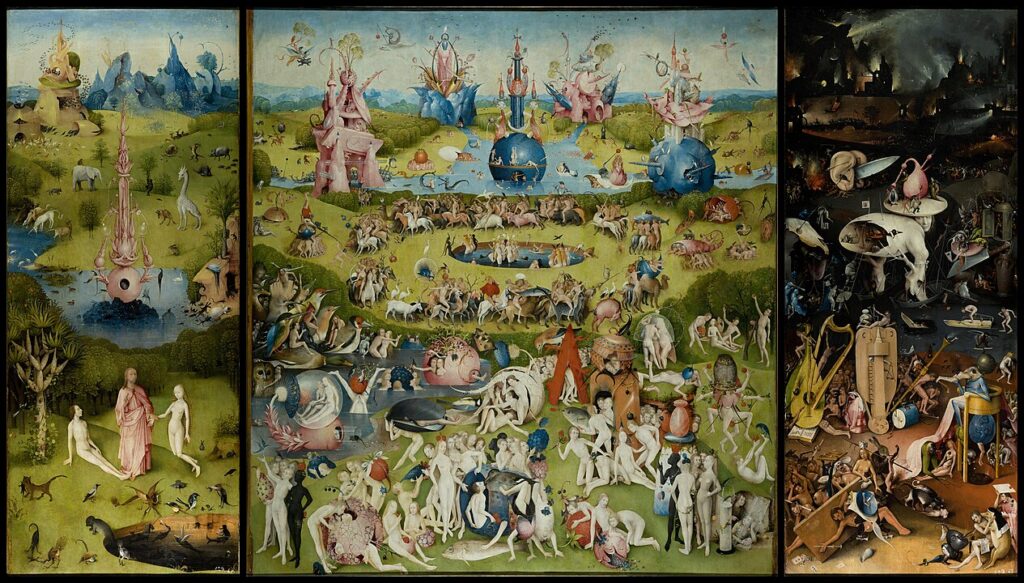
    The garden of earthly delights,  Hieronymus Bosch – 1500

    The paint delineates the world, commencing with creation on the left side and culminating in hell on the right.

    The left side, Eden’s garden

    On the left side of the paint, the creation, where the spring of life can be observed. However, an image then emerges that is wholly unanticipated and not directly associated with the customary imagery associated with the act of creation. It is conceivable to perceive God, embodied by an antiquated paradigm during Boch’s era, in the form of the figure of Christ. Eva’s genesis was recent, and she was positioned on the ground, in a state of supplication, with her hand held out towards the divine. Adam is depicted in a state of immobilisation, seemingly paralysed, gazing upon the original sinner who would subsequently repudiate the sanctity she had once acknowledged. It is conceivable to interpret the palm as the “tree of good and evil” on the basis that it is adorned with a snake.

    It is possible to interpret the initial segment of the painting as a prologue, hinting at the subsequent events that are to be depicted. On initial observation, the garden may appear to be a tranquil setting. However, upon closer inspection, several indications of turbulence emerge. The animals, engaged in combat, appear to be in staunch opposition to the notion of peace in a paradisiacal garden. These creatures can be interpreted as symbols of sin. The demon is hardly visible, lurking. It can be hypothesised that the cathedral, situated at the core of the composition, serves as a representation of the phallic symbol. This symbolisation could be interpreted as a representation of the sin of the flesh.

    the middle panel, the garden of earthly delights

    The image in question can be interpreted as a representation of desire, or more specifically, of a world in which the concept of paradise has been distorted, resulting in a semi-hellish environment.

    Whilst superficially appealing, a thorough examination reveals that it is representative of a corrupted humanity, one that is closer to hell and eternal damnation. This section of the painting is characterised by the presence of a significant amount of imagery, which serves to represent erotic themes and sexual practices. The depictions encompass both heterosexual and homosexual engagement. Interpretation of sexual interaction, even between animals and plants, is a further avenue for exploration.

    The fruits, frequently employed as a symbol of carnal desire, also functions as a metaphor for the ephemerality of sensual gratification, given that it is rapidly consumed and rapidly deteriorates. In the period of artistic production under discussion, avian imagery was frequently employed to symbolise lewdness. 

    It is evident that the inferior portion is replete with characters. However, upon closer inspection, one may discern that the figure almost concealed within the cave is Eva, with Adam positioned behind her. Adam is depicted as experiencing regret for his decision to consume the prohibited fruit and glaring at the world of doom in which he now finds himself ensnared.

    the right side, the hell

    It may appear to be an intriguing phenomenon, the extent of musical elements represented in hell. It is noteworthy to observe that by the era of the painting, Boch and numerous other figures had associated music with sin.

    The paint on this side is characterised by a sense of overwhelming aura, marked by a multitude of intricate details. The classical image of hell is characterised by depictions of fire and torture, which may be reminiscent of a city engulfed in flames.

    At the centre of the composition is a figure that is severely disfigured, with demonic entities manifesting as if dancing upon its cranium. The interior was devoid of life, occupied solely by a multitude of oppressive monsters. In the medieval period, it was a common practice to portray the contrast between extreme heat and bitter cold as a form of torture reserved for the infernal realm.

    In the lower section, the concept of music as a domain for sinners is emphasised, with musical instruments being depicted as instruments of torture. Additionally, the presence of a male figure holding a pig is noteworthy, which may symbolise regret and serve as a reference to the actions of men in the central panel.

    Evidently, there is a plethora of observations and interpretations to be made. This is an artwork that can be reimagined on numerous occasions throughout the course of a lifetime.
  • Exploring the potential meanings of some of my favourite paintings – The broken pitcher

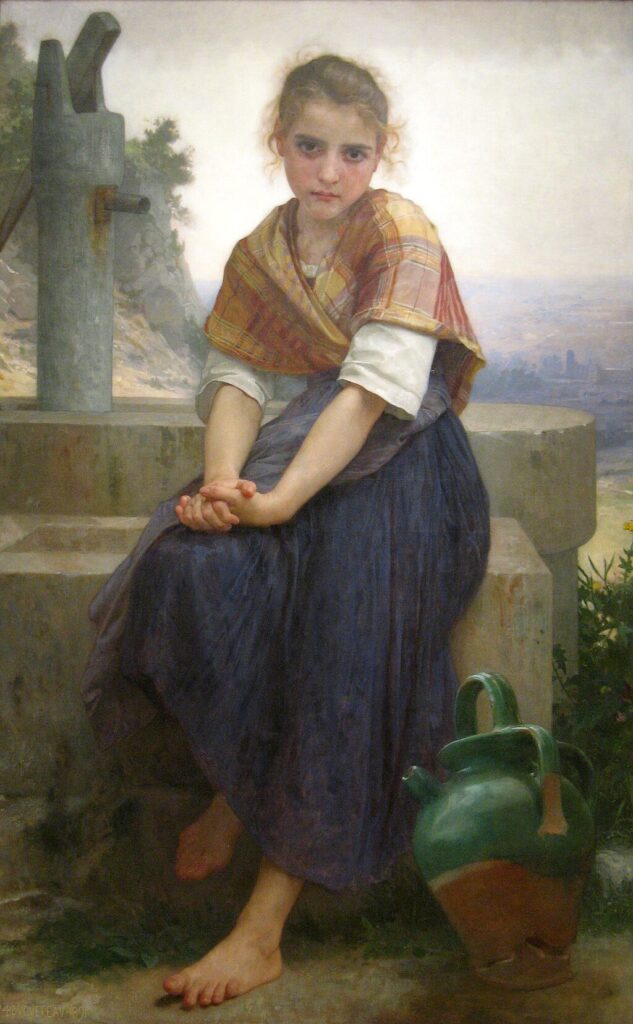
    The Broken Pitcher, William-Adolphe Bouguereau – 1891
    • The subject’s eyes appear to be incongruent with her age, suggesting the presence of more profound sentiments, potentially associated with anger or a predatory disposition.
    • The girl’s face appears slightly flushed, specially on the area of the cheeks, and beneath the eyes there are dark circles, indicating that she may have either wept or been deprived of sleep.
    • Notwithstanding the evident despondency conveyed by her posture and gaze, she is not weeping, nor does she exhibit any overt signs of distress. Rather, she appears to be making a conscious effort to maintain a neutral expression.
    • Painting of this nature, which was prevalent during the nineteenth century, frequently conveyed meanings related to vulnerability, sexual availability and emotional disturbance through the depiction of hair (Jones 1998, p. 123).
    • The subject has arranged her hair in a simple, minimalist style, with the back section tied back. This is an indication of decorum and humility, and the loose strands of hair serve to emphasise a sense of naturalness and simplicity, maybe rather than a rigid and overly contrived aesthetic. It is conceivable that the image in question may be a representation of post-sexual hair, characterised by its untidy state.
    • Determining her age is a challenging task, as there appears to be a dispute between the concepts of girlhood and womanhood.
    • It can be posited that the rigidity observed in this subject’s shawls is indicative of an internal struggle to maintain composure and self-possession, despite the presence of conflicting emotional sentiments.
    • The subject’s skin is characterised by its softness, pallor and evenness. These attributes can be interpreted as signals of innocence; however, no additional signals of innocence are evident in the painting.
    • It is possible that the body language of the subject could be interpreted as indicating feelings of shame and fear. This would include a slight hunching of the body, particularly of the shoulders, and arms held close to the body, which could be seen as a defensive gesture. Concurrently, it is not possible to ascertain whether she appears to be surprised. It is as if she was aware that the act was irreversible and perhaps even consented to it.
    • The subject is depicted without any shoes on, and in a state of exposed vulnerability. The notion of “childishness” is frequently associated with the concept of “barefootness“, yet the subject in question has seemingly transcended such a state. One foot is retracted, while the other remains in contact with the ground. This positioning may be indicative of a certain lack of formality, a degree of comfort, or even one more symbol of a vulnerability.
    • Her hands are firmly clasped, as if attempting to hold together a damaged object. She appears to be defensive in manner and exhibits a sense of unease in her personal sphere.
    • The paint, entitled “The Broken Pitcher”, put’s a pintcher right on the subject side. The fracture is not readily discernible, and while it is not as substantial, the damage to the pitcher is irreparable.
    • The city in the background may be a metaphorical representation of a future that has been lost, perhaps even a future that once existed in her conception and which is now in jeopardy.
    • The spatial distance between the subject and the city could be interpreted as a metaphor for moral or emotional detachment. If the interpretation of the broken pitcher as a metaphor for wrongdoing is valid, it could be interpreted that the subject has committed an act that is viewed negatively by society, and the city represents the judgement of this societal perspective. This judgement may be a consequence of the subject’s own volition, or as a result of shame or punishment.
    • It is evident that a spout is located adjacent to the subject, thereby providing an indication of the phallic symbol, which is commonly interpreted as representing the male reproductive organ.

    A prevalent interpretation of the painting suggests that it symbolises the loss of virginity of a pubescent girl.


  • About blood – let’s talk about Rh factor

    Much of what will be said here refers to the knowledge mentioned in the last post, about blood.

    The name ‘Rh’ is an acronym for ‘Rhesus factor’. This is because the first time scientists observed the Rh factor was during a blood analysis of Rhesus monkeys. Since then, we have discovered that Rhesus molecules are present in most life forms. Even some kind of bacteria carries Rh molecules.

    The Rh factor has an ancient origin, descending from the Amt molecule, which is found in every living thing, including Archea, the oldest living organism on Earth.

    Although Rh varies between species, they all have the same function. The similar DNA instructions they have are to carry and distribute gases within cells. The Amt do the same. They have a similar DNA to Rh molecules.

    The Rh factor is almost like a simplified version of the dynamics behind blood types. There are two main options: your Rh factor can be either positive or negative.

    As you probably remember, we all have two copies of almost all our genes, one from each parent. The RHD gene can have at least two versions: positive and negative. It’s easy to assume that two RHD+ genes will result in Rh+ blood. The same can be assumed with two Rh-.

    If one parent gives you an Rh+ gene and the other gives you an Rh- gene, you will be an Rh+ carrier for Rh- blood. This is because people with just one RHD gene produce enough protein to be Rh+. If you are Rh-, neither of your RHD genes knows how to produce the RHD protein.

    In simple terms, if you are Rh-, both of your parents must be carriers of the Rh- version of the RHD gene, which is fairly common.

    If you are a woman intending to become pregnant, it is important to be aware of the possibility of Rh incompatibility during pregnancy. This can happen if the mother is Rh-. This wouldn’t affect the first pregnancy, but could lead to problems in subsequent pregnancies.

    This is because, during birth, the blood of the mother and baby mixes. In an Rh- mother, her immune system is unable to recognise the Rh+ in the baby’s blood, so it will produce antibodies against it. This process takes time, so it will not be a problem for this pregnancy, but it will affect subsequent pregnancies.

    Since the mother’s immune system will already have antibodies against Rh+, her body will see the baby as an intruder and attack any Rh+ cells in the unborn baby. This is called Rh disease of the newborn. But there’s no reason to be afraid, since if you need, you can take a couple of RhoGAM shots during pregnancy, that prevents the mother’s immune system from harming the unborn baby.

    The RhoGAM’s function is to absorb all the Rh+ cells released from the baby, thereby preventing the mother’s body from mounting an immune response to them.


  • About blood

    My four-year-old daughter started the day by asking me a question about blood types. I was delighted to have the opportunity to share some of my knowledge on the subject with her. It made me want to go back to all those genetics classes I used to have and try to explain everything in a way that made sense. Since she didn’t seem interested in the topic, I’ll quickly run through a few things about blood types and Rh factors here (it’s a public holiday today, so I have some time).

    possible blood types

    Like many of our traits, blood types are genetically inherited. In simplified terms, it’s important to remember three things:

    • We have two copies of almost all of our genes.
    • Genes act as recipes for making proteins.
    • We have something called alleles, which are different versions of our genes.

    Our blood type is determined by three different versions of a gene, which we can call ABO.

    Since we inherit two versions of each allele, one from our mother and one from our father, each of our two copies can have a different version. The following table is a straightforward way to comprehend this:

    Genes inherited Blood type resultant
    AAA
    AOA
    BBB
    BOB
    ABO
    OOO

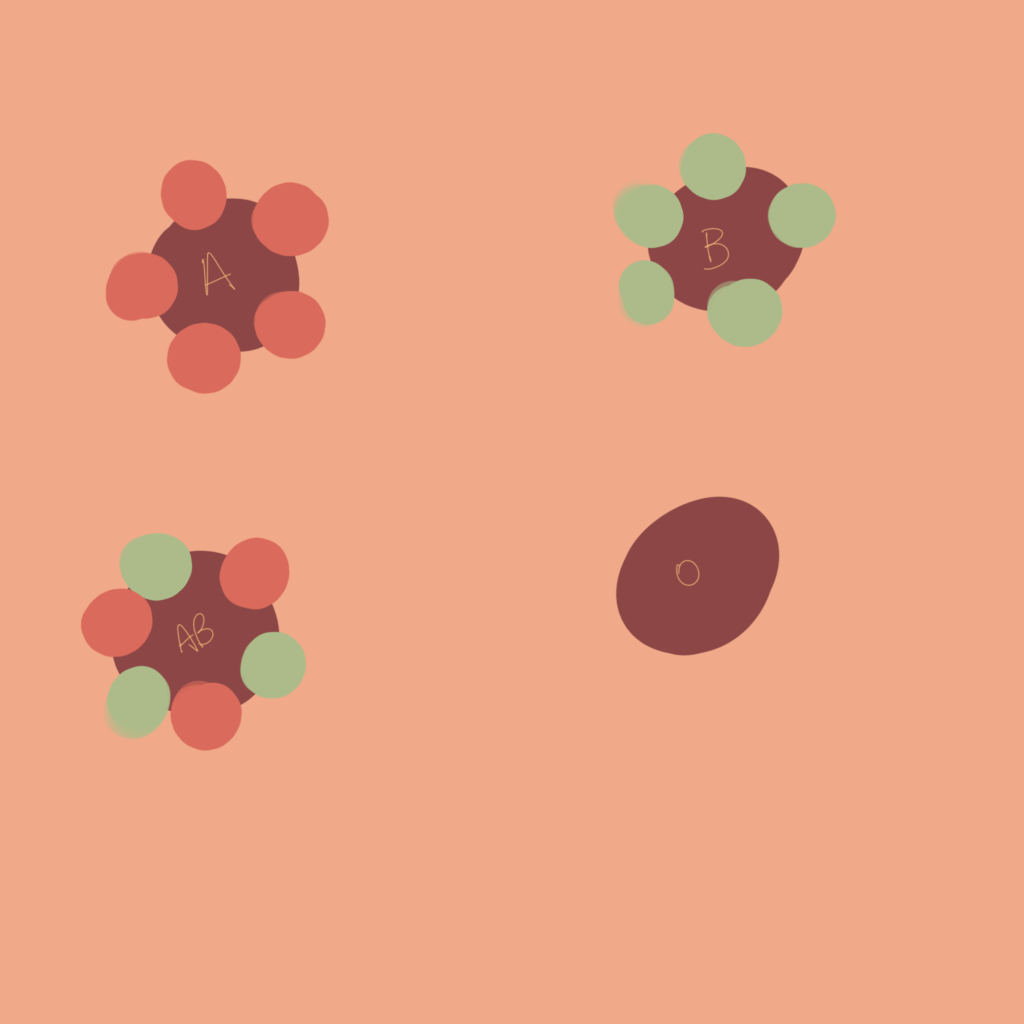
    There are tiny details outside our blood cells called antigens. It’s pretty simple.

    Blood typeAntigen
    AA
    BB
    ABAB
    ONO PROTEIN

    However, there is always an interesting new factor to consider: our DNA can change. It’s expected to change during our lifetime since there are many factors that can cause mutations in our DNA, such as our diet, sun exposure, age and chemicals in the air.

    These include our diet, sun exposure, age and chemicals in the air. It is thought that everyone had type A blood in the distant past, and that types B and O are mutations.

    DNA is made up of four different elements, which we call bases. Each gene is a formula for making a protein.

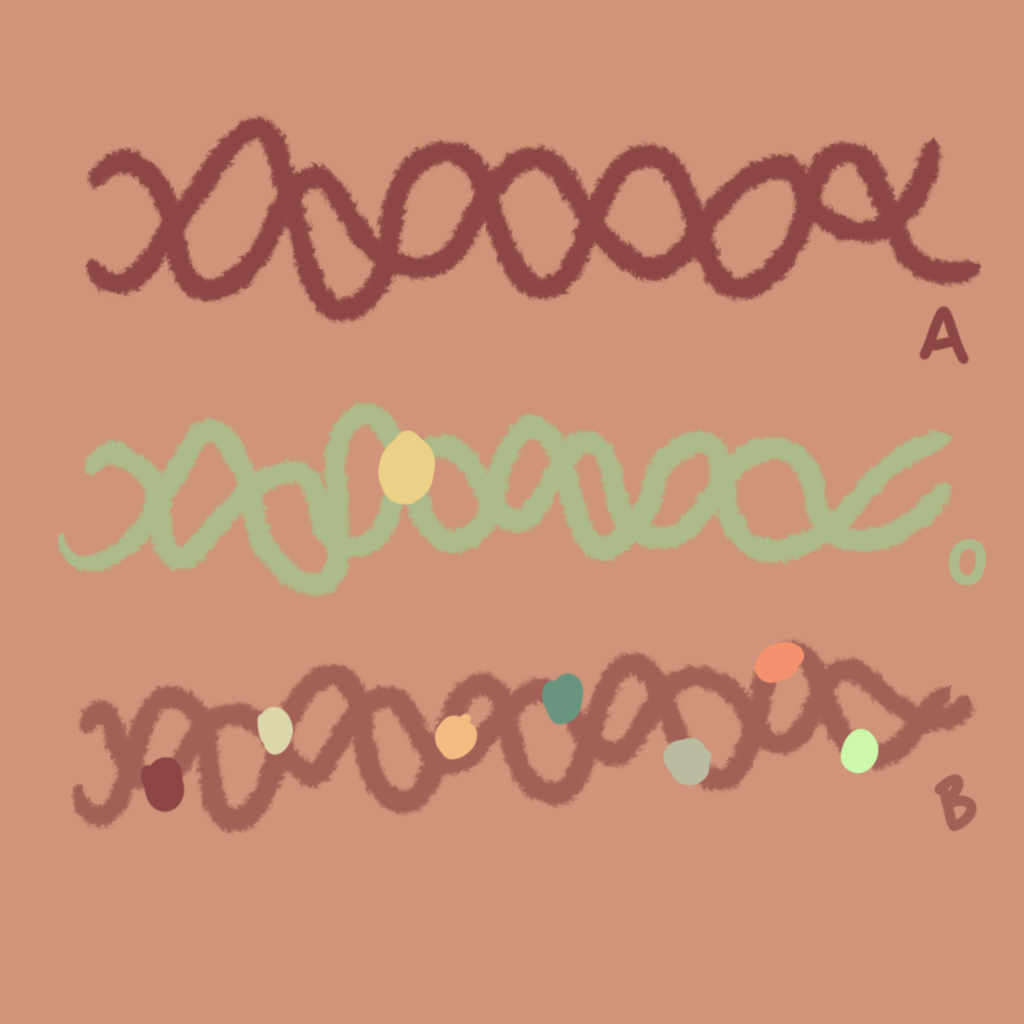
    The difference between type A and type O is one base (type O is missing this base), while the difference between type A and type B is seven bases.

    Our genes are read by cells in groups of three bases. Therefore, if just one base is different, it can alter the entire code. O is simply a modified version of A, which occurred at some point in the distant past and was able to survive and spread successfully.

    This justifies a mutation leading from an A type to an O type.

    We can also observe that an O type can generate an A type, but this is much rarer. The odds of this specific change occurring are around 1 in 50 million. Therefore, it is possible for two type O parents to have a type A child, but it is not very probable.

    Similarly, it is possible for O-type parents to have a B-type child, but this is highly unlikely, as it is improbable that seven bases would change simultaneously to produce a recipe for B-type blood from O-type blood.

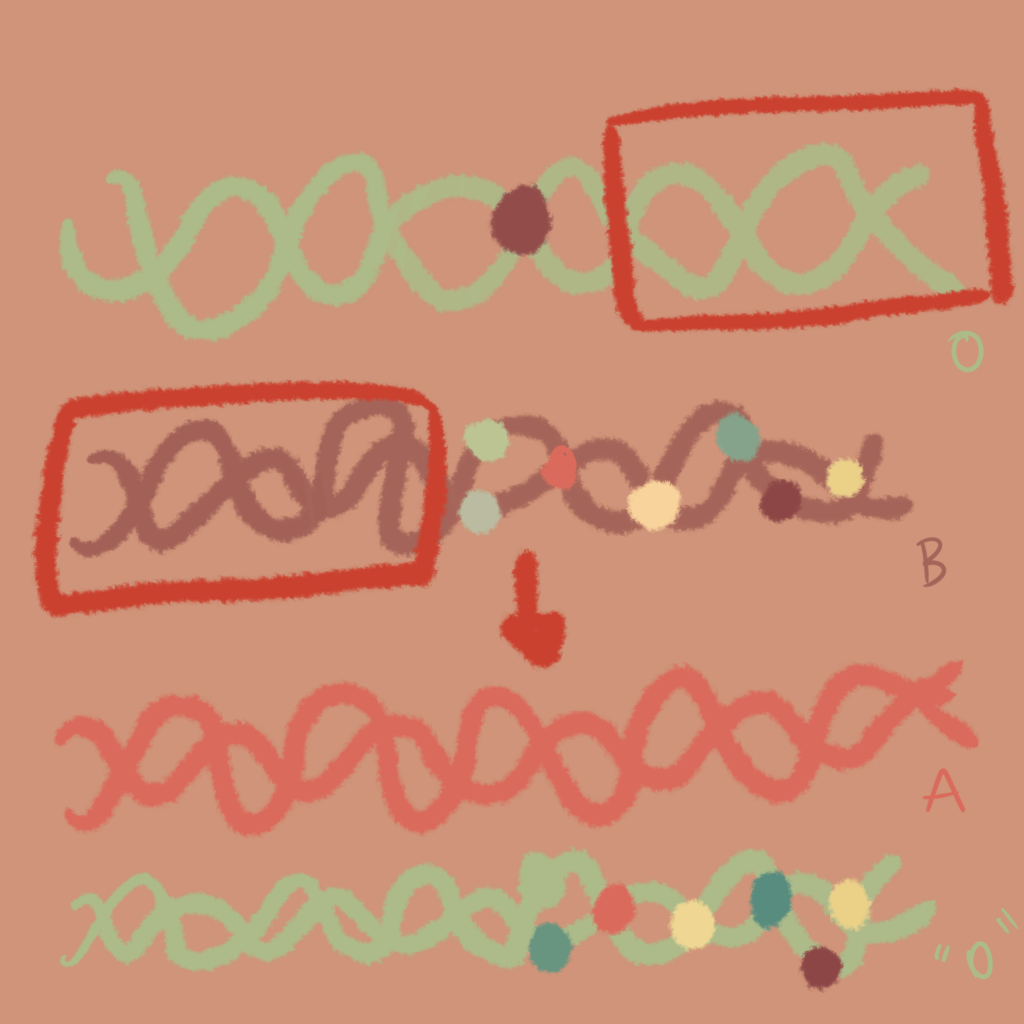
    There are different types of mutation that can result in two B-type parents having an A-type child. This happens because of recombination.

    Since each person has two different forms of a gene (called alleles), one from each parent, we can see how recombinations can occur.

    An example:

    A woman have type B and type O alleles, which results in type B blood. When her body produces eggs, it chooses which allele it will carry. It can be type O, coming from one parent, or type B, coming from the other.

    Type O alleles are almost type A alleles, they’re just missing one little base. If, for a reason, this one base is replaced, it can works just like a type A.

    Recombination, where we swap part of O of B, making an A type.

    This way, if this woman have children with a O type father, the child could have A type blood, even though neither parent have an A type allele. If she have kids with an B type man, the child could have AB blood type.

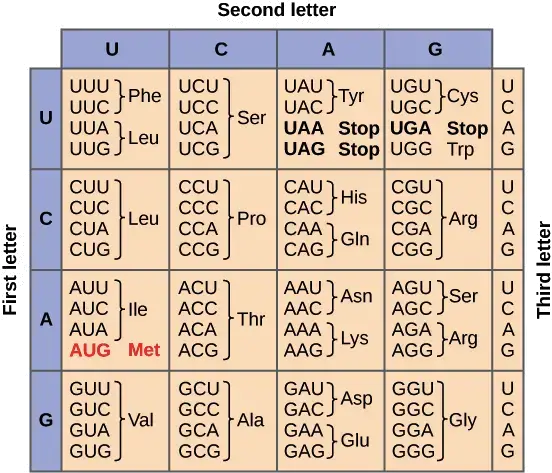
    We have something called amino acids, that are like Lego parts to build a protein. There are 20 different types of this building blocks.

    The ABO gene have the following sequence of DNA Bases:

    GTC CTC GTG GTG ACC CCT TGG

    This sequence is read by the cell as instructions to make a protein using the following amino acids (Lego pieces):

    Val Leu Val Val Thr Pro Trp

    What if one of the “G” base, right on the middle, is taken out? All the following bases would get shifted to the left, resulting in something like

    GTC CTC GTG GTA CCC CTT GGC

    Which would result in a protein builded with the pieces

    Val Leu Val Val Pro Leu Gly

    This is a mutation. As you can see, it’s a completely different set of amino acids (what makes a totally different protein!).

    How the cell know when it reached the end of the gene, so it can stop reading? As you can see on the table above, there’s certain combinations that acts like a stop sign. In this case, when the “G” base got missing, the cell finds a stop signal earlier than it should. This is exactly why two type A can have type O children!

    rare exceptions on blood type inheritance

    There are rare exceptions on the blood rules. We can basically summarise it as

    • Chimerism
    • Cis-AB type
    • Uniparental dissomy
    • Bombay group
    • New Mutations

    chimerism

    We call chimerism when one person has two different sets of DNA. It can happen because of:

    • Bone marrow transplant, when the recipient will have the blood type of the donor, but their sperm or eggs would still have the original DNA and blood type
    • Fusion chimerism, when a twin pregnancy combines generating a single baby with both twin’s sets of DNA
    • Blood chimerism, when fraternal twins share blood during pregnancy, causing mixing cells

    cis-AB TYPE

    There’s a rare version of ABO gene, which can result in AB type by itself. On this case, two AB parents could have an O type child and one AB type parent + one O type parent could have an AB type child.

    uniparental dissomy

    It happens when a child inherits both sets of chromosomes from a single parent. It’s very rare.

    bombay group

    It’s a recessive blood type caused by a variant at different blood type genes. This type look like an O type, no matter which ABO type they have.

    new mutations

    This is pretty rare, but new and less documented mutations can occur.

    When we consider this exceptions, the have a table of combinations that look like that:

    possible blood types chart

    Parent 1Parent 2Expected blood type resultant Rare exceptions
    AAA, O B, AB – If either parent is a chimera
    ABA, B, AB, O Non existent
    AABA, B, ABO – If the AB parent is a chimera or has cis-AB type. Also possible that both parents carry Bombay group
    AOA, O B – If either parent is a chimera or if O parent carries Bombay
    AB – If the O parent is a chimera or carries Bombay
    BBB, O A, AB – If either parent is a chimera
    BOB, OA – If either parent is a chimera or if the O parent carries Bombay
    AB – If the O parent is a chimera or carries Bombay
    ABABA, B, ABO – If both parents are carriers of Bombay or have cis-AB type
    AB OOO – If the AB parent is a chimera or has cis-AB type or if both parents carriers Bombay
    AB – If the AB parent has cis-AB type or if the O parent carriers Bombay
    OOOA – If either parent is a chimera or carriers Bombay
    B – If either parent is a chimera or carriers Bombay
    AB – Both parents are chimera or carriers of Bombay group

    Besides blood types, there’s also a lot of things to consider when we think about Rh factor, but this will have to be discussed on a further post, since Fritz is already boring meowing for me.


  • Back to ‘21

    A glimpse of my year of 2021.


Natimorto