

The financial implications of a coup must be thoroughly examined. So, how much does a coup coasts?
In April 1953, the CIA was granted a budget of 1,000,000 US dollars to fund the operation. This could be used in any way to overthrow Mosaddegh. Another important factor influencing US interests was the fear of a communist takeover and its spread in the region due to the growing influence of the Communist Tudeh Party and the Soviet Union.
As usual, the US decided that it should control a larger share of Iranian oil supplies.
Operation Ajax, also known as TPAJAX, was conceived and executed by the US Embassy in Tehran. The operation had four main parts:
The operation was a collaboration between the CIA, the British government and the Shah, coordinated with his twin sister, Princess Ashraf.
Moreover, an internal CIA memorandum, entitled “Campaign to Install Pro-Western Government in Iran”, specifies that one of the CIA’s primary objectives in Iran was to “disenchant the Iranian population with the myth of Mossadegh’s patriotism, by exposing his collaboration with the Communists and his manipulation of constitutional authority to serve his own personal ambitions for power.”
The reputation of Mosaddegh was subject to deterioration as a consequence of propaganda campaigns that erroneously associated him with communism and denigrated the Iranian people. A plot was initiated with the objective of deposing the democratically elected leader.
The Central Intelligence Agency (CIA) allocated a significant budget to facilitate the operation. The final cost is estimated to vary between $100,000 and $20 million, depending on the expenses to be counted. Following the overthrow of the Zahedi government, the Central Intelligence Agency provided the new regime with $5 million, with Zahedi himself receiving an additional $1 million.
The consequences of the coup was the subsequent Iranian Revolution (1979), which occurred 25 years later, resulted in the establishment of an Islamic republic in Iran that was anti-Western and based on the concept of Velâyat-e Faqih .1
The following discussion will explore the manner in which the 1953 coup d’état established the foundations for the 1979 revolution.
The Iranian populace viewed the coup as a brazen act of foreign interference, which undermined national sovereignty and served to reinforce the prevailing perception of Western powers as both hostile and exploitative. This sentiment found resonance with various groups, including religious leaders and intellectuals, who perceived the coup as a symbol of Western dominance and a betrayal of Iranian interests.
The military takeover effectively reinstated the Shah to his former position of authority, thereby removing a popularly elected leader and consolidating the monarchy’s hold on power. However, this also resulted in the deepening of the Shah’s reliance on Western powers, thereby engendering a sense of resentment among a significant proportion of the Iranian populace who perceived the Shah as having become a puppet of foreign interests.
The coup provided a unifying catalyst for both the burgeoning nationalist and Islamist movements that were experiencing a period of heightened popularity in the 1950s and 1960s. These movements regarded the Shah’s pro-Western policies and his reliance on the military as a betrayal of Iranian values and national interests.
The Shah’s government lost its legitimacy as a result of the coup, and an alternative political and religious groups were able to gain influence due to the vacuum of leadership that was created. This vacuum was subsequently filled by Ayatollah Khomeini and his supporters, who successfully exploited the anti-establishment sentiment and the Shah’s waning popularity.
The sequence of events that led to the 1953 coup, in combination with the Shah’s escalatingly authoritarian policies and his mounting unpopularity, engendered a conducive environment for revolutionary action. The revolution, which commenced in 1978, ultimately succeeded in overthrowing the Shah and establishing the Islamic Republic of Iran.
The setting is Iran in the year 1882. Tehran. A child was born. His father, Mirza, held the position of Minister of Finance in Iran, while his mother, Najm, was related to the ruling Qajar dynasty 1. At the age of ten, Mohammad was bereaved of his father, who passed away due to cholera. He was subsequently left to care for his mother and sister.
At the age of 12, the monarch Nasir al-Din Shah bestowed upon him the title of “Mossadegh al-Saltaneh“. Subsequently, he adopted the surname “Mossadegh“, which translates as “true and authentic“.
His professional life commenced at the age of 15, when he was designated Mostofi (Chief of Finance) of Khorosan Province in honour of his father.
The constitutionalist movement of 1905–1911 held active participation in the events that led to the establishment of a constitutional monarchy, thus substituting the former system of arbitrary monarchical rule. In 1906, at the age of 24, he was elected to the first Majles (Parliament) as a representative of the people of Esfahan. However, he withdrew his name from consideration, since he was below the legal age requirement.
He pursued his studies in political science in Tehran, subsequently continuing his education in Paris. During his sojourn in Paris, the young man exhibited symptoms consistent with a diagnosis of chronic fatigue syndrome. This ultimately compelled him to return to Iran.
Subsequently, he relocated to Switzerland to pursue his Law education. In 1914, he became the first Iranian to be awarded a doctorate in law, and returned to his homeland on the eve of the First World War.
In 1917, he was employed by the government in the capacity of Deputy Secretary of the Ministry of Finance, with the objective of combating corruption. In 1919, the subject self-exiled to Switzerland in protest at an agreement between Iran and Britain. The agreement stipulated the transfer of responsibility for the supervision of Iran’s army and financial systems to British advisers. Following the rejection of the agreement by the Majles, he returned to Iran.
Following his return to Iran, he was invited to assume the role of governor of Fars province. However, a few months later, he resigned in protest at the 1921 British-inspired coup in Tehran2, which ultimately led to the establishment of the Pahlavi dynasty in 1925.
Following his tenure as governor of Fars, he assumed the role of Finance Minister in the government of Prime Minister Ghavam. Subsequently, he was appointed Minister of Foreign Affairs, and subsequently served as Governor of the Azerbaijan province for a brief period. In 1923, he was elected to the 5th Majles, thus marking the inception of his historic opposition to the establishment of the Pahlavi dynasty by Reza Khan, who was British-supported and at the time the Prime Minister of Iran.
The reign of Reza Shah was very oppressive and had amongst the greatest threats to the new administration the Persian Soviet Socialist Republic, which had been established in Gilan, and the Kurds of Khorasan. In 1928 he withdrew from social and political activism and retreated to his village, about 100 kilometers outside Tehran, during a decade.
In July 1940, Reza Shah’s police squad raided his residence. Despite the absence of incriminating evidence, he was imprisoned in the central prison in Tehran. He was subjected to interrogation and subsequently transferred to a prison in Birjand, with no charges brought against them. As an individual held in high esteem by the community and recognised for his opposition to the arbitrary rule of Reza Shah, he was anticipated to be targeted for assassination.
By the age of 13, Khadijeh, his daughter, had been profoundly traumatised by her father’s violent arbitrary arrest and was subsequently institutionalised in psychiatric hospitals for the remainder of her life.
In November 1940, Reza Shah released him and transferred Mossadegh to Ahmedabad (India), where he was to reside until his death. A year later his house arrest ended when the British forced the abdication of Reza Shah and his 22 years old ascended to the throne.
As a consequence of the events which took place in 1944, Mossadegh was elected with overwhelming support as Tehran representative, thus returning to political activities. During his tenure, he was instrumental in the fight for Iran’s political and economic independence from foreign influence. A key element of this was the renegotiation of the unfavourable oil agreement with the Anglo-Iranian Oil Company, a move that garnered significant popular support.
The contemporary history of Iran has been inextricably linked to oil, a highly sought-after energy source by the West. The origins of this matter can be traced back to 1901, when an exclusive rights agreement was granted to William Knox D’Arcy, a British national, for the purpose of oil exploration. This agreement was valid for a period of 60 years.
The issue of exploitation in Iran’s southern provinces is a contentious one. The year 1908 marked the discovery of oil in the region, leading to the establishment of the Anglo-Persian Oil Company. In the period preceding the outbreak of the First World War in 1914, the British government acquired a 51% stake in the company’s shares. The British thus established a beachhead and effectively colonised the southern west corner of Iran, exerting a direct and indirect influence on the political affairs of the entire country. APOC demonstrated a flagrant disregard for the principles of equitable remuneration by withholding a substantial portion of the agreed profit sharing payment to Iran, amounting to a mere 16%. This egregious act was further compounded by a flagrant display of disdain and racial prejudice towards Iranian oil workers within their own country. The situation reached a critical juncture in July 1946, when approximately 6,000 Iranian oil workers initiated a strike in the oil city of Aghajari. The conflict with government troops resulted in significant fatalities and injuries among the workers, with more than 200 casualties.
Mossadegh’s objective was to terminate 150 years of British political interference, economic exploitation and the plundering of Iran’s national resources, and to proceed with the nationalisation of the oil industry. The primary objective was not revenue generation, but rather, the attainment of independence from the British.
The initial presentation of the nationalisation plan to the Majles “Oil Commission” was made on 8 March 1951. The following day, a coalition of several political parties held a major rally in support of the nationalisation of the oil industry. On the occasion of the Iranian New Year, which was celebrated on 20 March 1951, the National Front Bill for Oil nationalisation was accepted by the Senate. Exactly one month later, Dr. Mohammad Mossadegh was nominated for the position of prime minister, which he subsequently won by securing the support of almost 90% of the representatives present.
The dispute with the Anglo-Iranian Oil Company (hereafter AIOC) led to an escalation in tensions between Iran and Britain. In response, the British government implemented economic sanctions and cautioned military intervention. In June 1951, the Iranian government uncovered a British spy network that exposed subversive activities by a significant number of politicians and journalists.
In response to the aforementioned events, the Iranian government took the decision to close the British consulate. In October 1951, Prime Minister Mossadegh travelled to New York with the intention of defending Iran’s right to nationalise its oil industry in front of the UN Security Council. He then proceeded to Washington, where he engaged in a meeting with President Truman, but ultimately did not achieve his objective.
Upon his return to Iran in November 1951, he made a stopover in Cairo, where he was greeted by a group of admirers who had gathered to express their enthusiasm for his return.
In June 1952, Jue presented nearly 200 documents to the International Court in the Netherlands. These documents revealed the highly exploitative nature of the AIOC and the extent of its political intervention into the Iranian political system.
Upon returning to Iran, it became evident that the economic and security conditions were rapidly deteriorating, and that the subversive activities of foreign powers were increasing. In July 1952, Mossadegh submitted a formal request to the monarch, Reza Shah, who concurrently served as the head of the military, seeking to assume control of the armed forces. The Shah’s refusal to comply led Mossadegh to tender his immediate resignation as Prime Minister.
On the following day, the nomination of the new Prime Minister, Ahmad Ghavam, was announced. He was selected by the Shah, at the behest of the British and American governments. Massive protests occurred, resulting in hundreds of casualties. Intimidated by the people’s support for Mossadegh, the Shah’s pointed Mossadegh to the dual role of prime minister and minister of defense. In the ensuing days, the International Court delivered its decision in favour of Iran with regard to the ongoing oil-related dispute. Subsequently, the UN Security Council dismissed the British complaint against Iran. At this juncture, Moosadegh wielded considerable political influence, both within Iran and across the broader Middle Eastern region.
As a political leader of Iran, he was responsible for the sponsorship of legislation for independent court systems, the defence of freedom of religion and political affiliation, and the implementation of social reforms. He was a defender of the rights of women, workers and peasants, created a fund to pay for rural development projects and followed a principle of negative equilibrium, an idea that led to the formation of the non-allied nations, refusing also to grant the oil concession to the soviet Union. The objective of the programme was to foster national self-sufficiency, balance the budget, increase non-oil productions and create a trade balance. The policies enacted by the aforementioned leader were often met with opposition from the Shah, in addition to the governments of Britain and the United States.
Concurrently, the British government pursued a policy of subverting Mossadegh’s authority, fomenting domestic discord, and intensifying the global embargo on Iranian oil exports, while also freezing Iranian assets. In the face of mounting challenges and setbacks, the British initiated a collaborative effort with the US CIA, formulating a strategy to depose the democratically elected government in power.
On 15 August 1953, the CIA, with the involvement of the Shah and other Iranian collaborators, drafted a plan entitled Operation Ajax. This plan was intended to dislodge Mossadegh from power; however, it was unsuccessful. The second attempt was made on 19 August 1953, and the violent overthrow of the government was accomplished. The second attempt was made on 19 August 1953, and the violent overthrow of the government was accomplished. Mossadegh managed to evade capture, yet his residence was subsequently raided and set alight.
On the subsequent day, Mossadegh submitted to the authorities and was promptly imprisoned. During this event, hundreds were killed or wounded. He was subjected to a military trial on charges of treason on 19 December 1953. He was convicted of treason and consequently sentenced to a period of solitary confinement lasting three years, followed by house arrest for the remainder of his life. He passed away at the age of 84.
Mossadegh committed the grave transgression by endeavouring to safeguard the interests of his nation, namely by ensuring the continued nationalisation of Iran’s oil industry, with a view to circumventing the political and economic exploitation perpetrated by the British and the US Americans.
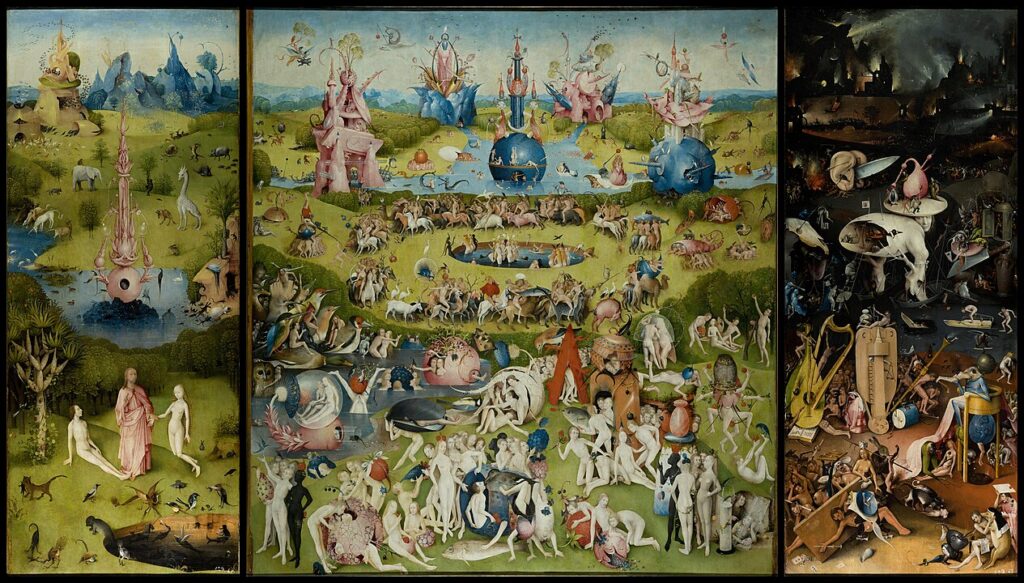
The paint delineates the world, commencing with creation on the left side and culminating in hell on the right.
On the left side of the paint, the creation, where the spring of life can be observed. However, an image then emerges that is wholly unanticipated and not directly associated with the customary imagery associated with the act of creation. It is conceivable to perceive God, embodied by an antiquated paradigm during Boch’s era, in the form of the figure of Christ. Eva’s genesis was recent, and she was positioned on the ground, in a state of supplication, with her hand held out towards the divine. Adam is depicted in a state of immobilisation, seemingly paralysed, gazing upon the original sinner who would subsequently repudiate the sanctity she had once acknowledged. It is conceivable to interpret the palm as the “tree of good and evil” on the basis that it is adorned with a snake.
It is possible to interpret the initial segment of the painting as a prologue, hinting at the subsequent events that are to be depicted. On initial observation, the garden may appear to be a tranquil setting. However, upon closer inspection, several indications of turbulence emerge. The animals, engaged in combat, appear to be in staunch opposition to the notion of peace in a paradisiacal garden. These creatures can be interpreted as symbols of sin. The demon is hardly visible, lurking. It can be hypothesised that the cathedral, situated at the core of the composition, serves as a representation of the phallic symbol. This symbolisation could be interpreted as a representation of the sin of the flesh.
The image in question can be interpreted as a representation of desire, or more specifically, of a world in which the concept of paradise has been distorted, resulting in a semi-hellish environment.
Whilst superficially appealing, a thorough examination reveals that it is representative of a corrupted humanity, one that is closer to hell and eternal damnation. This section of the painting is characterised by the presence of a significant amount of imagery, which serves to represent erotic themes and sexual practices. The depictions encompass both heterosexual and homosexual engagement. Interpretation of sexual interaction, even between animals and plants, is a further avenue for exploration.
The fruits, frequently employed as a symbol of carnal desire, also functions as a metaphor for the ephemerality of sensual gratification, given that it is rapidly consumed and rapidly deteriorates. In the period of artistic production under discussion, avian imagery was frequently employed to symbolise lewdness.
It is evident that the inferior portion is replete with characters. However, upon closer inspection, one may discern that the figure almost concealed within the cave is Eva, with Adam positioned behind her. Adam is depicted as experiencing regret for his decision to consume the prohibited fruit and glaring at the world of doom in which he now finds himself ensnared.
It may appear to be an intriguing phenomenon, the extent of musical elements represented in hell. It is noteworthy to observe that by the era of the painting, Boch and numerous other figures had associated music with sin.
The paint on this side is characterised by a sense of overwhelming aura, marked by a multitude of intricate details. The classical image of hell is characterised by depictions of fire and torture, which may be reminiscent of a city engulfed in flames.
At the centre of the composition is a figure that is severely disfigured, with demonic entities manifesting as if dancing upon its cranium. The interior was devoid of life, occupied solely by a multitude of oppressive monsters. In the medieval period, it was a common practice to portray the contrast between extreme heat and bitter cold as a form of torture reserved for the infernal realm.
In the lower section, the concept of music as a domain for sinners is emphasised, with musical instruments being depicted as instruments of torture. Additionally, the presence of a male figure holding a pig is noteworthy, which may symbolise regret and serve as a reference to the actions of men in the central panel.
Evidently, there is a plethora of observations and interpretations to be made. This is an artwork that can be reimagined on numerous occasions throughout the course of a lifetime.
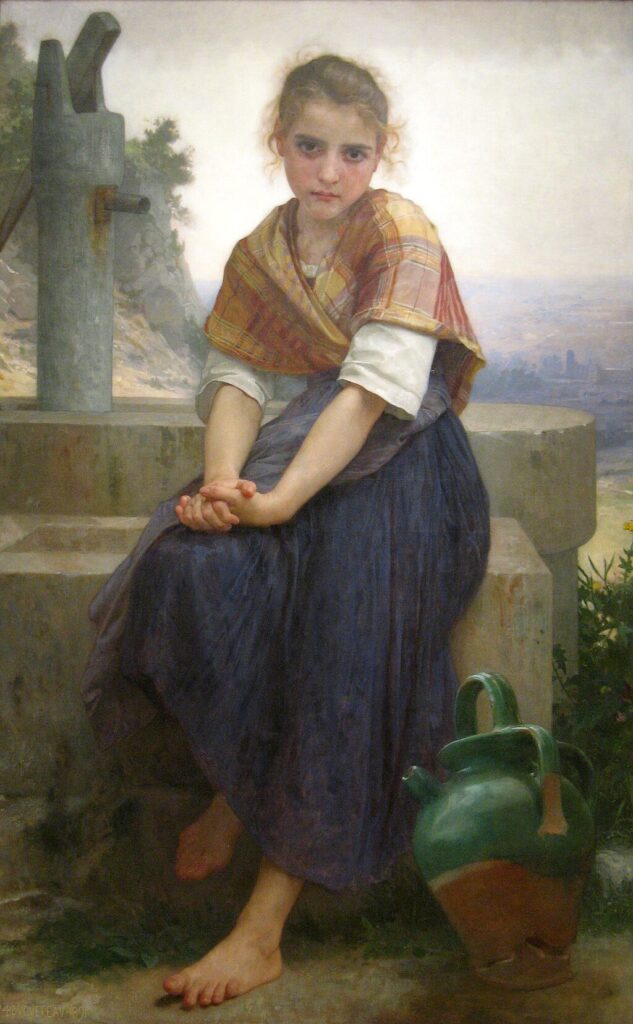
A prevalent interpretation of the painting suggests that it symbolises the loss of virginity of a pubescent girl.